

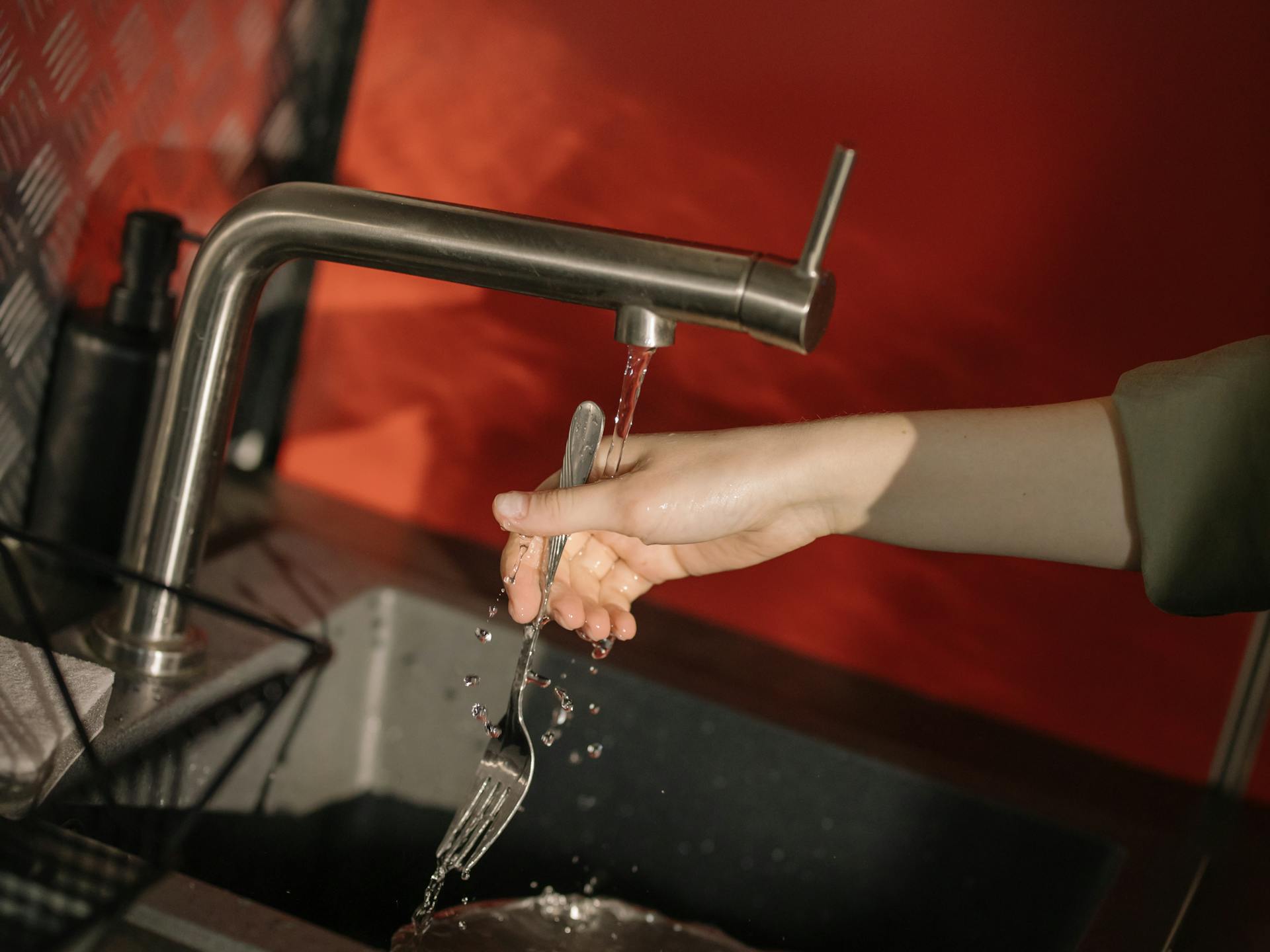

Las Vegas water is hard. The Las Vegas Valley Water District puts it at roughly 280 to 291 parts per million, or about 16 to 17 grains per gallon, which it classifies as “very hard.” That mineral load is what leaves white crust on faucets, cloudy spots on glassware and scale inside your water heater.
The two most common whole-home fixes are a traditional salt-based water softener and a salt-free water conditioner. They are often sold as if they do the same job, but they don’t. Here is how each one works, what independent research says, and how to decide which one fits your home.
How a salt-based water softener works
A water softener uses a process called ion exchange. Water flows through a tank of resin beads that hold sodium (or potassium) ions. The beads grab calcium and magnesium, the two minerals that make Southern Nevada’s water hard, and release sodium in their place.
As Penn State Extension explains, the resin eventually fills up with hardness minerals. The softener then regenerates by rinsing the beads with salt brine from a separate tank and flushing the captured minerals down the drain.
The result is water that is actually soft. The Water Quality Association (WQA) defines soft water as less than 1 grain per gallon of hardness, and that is what a properly sized, properly set softener is designed to deliver.
Our Professional Series water softeners come with computerized, timer or manual regeneration control. Computerized control regenerates based on how much water you actually use. The WQA’s best-practice guide for softeners recommends this kind of demand-initiated regeneration over time clocks because it uses less salt and water.
How a salt-free water conditioner works
A salt-free conditioner does not remove calcium and magnesium. Instead, it changes how those minerals behave so they are less likely to stick to pipes, fixtures and heating elements as hard scale. There is no brine tank, no regeneration cycle and no wastewater.
That difference matters. The WQA notes that anti-scale devices do not reduce the total calcium or magnesium in the water and are not proven to produce soft water. The Southern Nevada Water Authority’s home treatment systems guide goes a step further and calls the “salt-free softener” label a misnomer, because these systems condition water rather than soften it.
Our ScalePrep salt-free scale control system falls into this category. It uses no salt and no chemicals, and the conditioning media doesn’t need filter changes. Calcium and magnesium stay in the water while the system works to keep them from forming scale.
What the research says about salt-free systems on Colorado River water
Salt-free products vary a lot, so it helps to look at independent testing. One of the more relevant studies for Southern Nevada was led by Arizona State University for the WateReuse Research Foundation and published in 2014. Researchers tested several alternatives to ion exchange softeners on two waters, one of them Colorado River water, the same source that fills Lake Mead.
- Template assisted crystallization (TAC), a common type of salt-free media, reduced scale formation by more than 88 percent compared with untreated water.
- Electromagnetic and electrically induced precipitation devices reduced scale by roughly 50 percent.
- Ion exchange softening also reduced scale effectively, as expected, but it does so by removing the hardness and producing brine.
The researchers were careful to note limits. The testing used an accelerated, high-temperature protocol, and the results don’t establish long-term performance. In plain terms: a well-designed salt-free system can greatly reduce scale, but results depend on the product, how it is sized and installed, and your water. It will not make your water soft.
Side-by-side: softener vs. salt-free conditioner
- Hardness minerals: A softener removes them. A salt-free conditioner leaves them in the water.
- How the water feels: Softened water lathers easily and has the slick feel many people like. Conditioned water feels like regular tap water.
- Spots on glass and fixtures: The LVVWD notes that mineral residue forms when water evaporates. Softened water has very little hardness left to leave behind. With a conditioner the minerals are still there, so expect some spotting where water dries, such as on shower glass.
- Sodium: Penn State Extension estimates that softening adds about 7.5 milligrams of sodium per quart for every grain per gallon of hardness removed. At roughly 16 grains, that works out to about 120 milligrams per quart. Salt-free systems add no sodium.
- Water use: Softeners use water to regenerate. Penn State puts a regeneration at around 50 gallons, which is why efficient, demand-controlled models matter. Conditioners don’t regenerate.
- Upkeep: Softeners need regular salt refills and periodic checks. Salt-free conditioners need very little routine attention.
- Drain: Softeners need somewhere to send regeneration water. Our manually controlled models are an option where a permanent drain isn’t available. Conditioners don’t need a drain.
Which is right for your Las Vegas home?
A water softener is usually the better fit if you want truly soft water, the fewest spots on glass and shower doors, rich lather and the strongest protection against scale. It is also the stronger choice if you already fight heavy buildup on fixtures and appliances and don’t mind adding salt.
A salt-free conditioner is usually the better fit if you want scale protection without salt bags, brine or regeneration water, you’d rather keep the minerals in your water, or your home doesn’t have a convenient drain near the main line. If anyone in your home has been told to limit sodium, the SNWA advises people with specific medical conditions to discuss water treatment options with their physician. A salt-free system, a potassium-based softener or a drinking water system are all worth raising in that conversation.
For a deeper look at what softening costs over time, see our guide to water softener costs in Las Vegas.
Pair either option with filtration
Neither a softener nor a conditioner is designed to remove chlorine. The LVVWD adds chlorine as water leaves its treatment facilities to protect it on the way to your tap, and that is the taste and smell many residents notice. A whole-house carbon filter addresses chlorine at every faucet. Keep in mind that carbon filters do not remove hardness, minerals, sodium or fluoride, so they complement a softener or conditioner rather than replace one.
For drinking water, a reverse osmosis system at the kitchen sink is a common final step. The SNWA notes that reverse osmosis is the only home filter type that removes calcium and magnesium, and it also reduces the sodium a softener adds.
Frequently asked questions
Does a salt-free conditioner work on 16 to 17 grain Las Vegas water?
It can reduce scale, but it doesn’t remove hardness. In the Arizona State University study, TAC media reduced scale by more than 88 percent on Colorado River water under accelerated test conditions. Real-world results depend on the product, sizing and your home’s water use.
Is softened water safe to drink?
Softened water is commonly used throughout the home, but it does contain added sodium. Penn State Extension flags this for people on low-sodium diets. Many homeowners pair a softener with a reverse osmosis system for drinking and cooking water.
Can I switch from a softener to a salt-free system later?
Yes. Both are installed where water enters the home, so switching is usually a matter of swapping equipment. A water analysis will show whether your current setup is doing its job and which option suits your household.
Not sure where your home stands? Water Quality of Las Vegas is locally owned and offers a free water analysis with same-day service available and 100% financing. Call or text 702-623-2724 any time, 24/7, or contact us online to schedule your visit.