
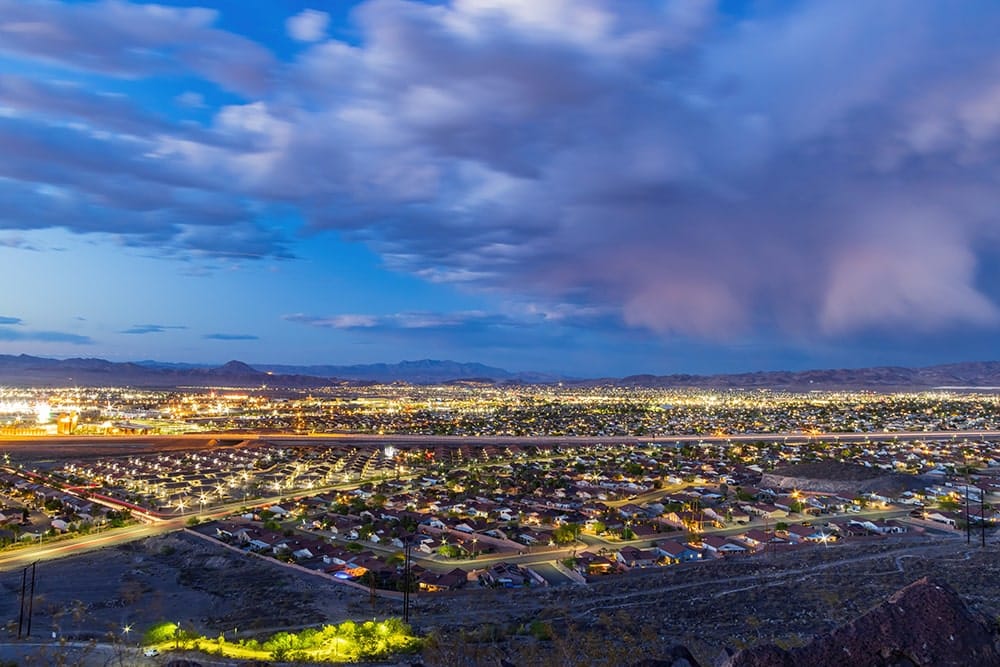

If you live in Henderson, you have probably noticed the white crust on your faucets, the spots on your glassware and the film on your shower doors. Those are all signs of hard water, and Henderson’s water is very hard.
According to the City of Henderson’s 2024 Water Quality Report, the city’s water typically measures 267 parts per million, or 16 grains per gallon, of hardness. Below we break down what that number means, where the minerals come from and the practical options Henderson homeowners have for dealing with it.
Henderson’s water hardness by the numbers
Hardness is a measure of dissolved calcium and magnesium. It is usually reported in parts per million (ppm, the same as milligrams per liter) or grains per gallon (gpg). Here is how Henderson’s water stacks up:
- City of Henderson: typically 267 ppm, or 16 gpg, which the city categorizes as “very hard.”
- Las Vegas Valley Water District: about 280 to 291 ppm, or 16 to 17 gpg, for the water it delivers across the valley.
- U.S. Geological Survey scale: the USGS classifies water above 180 mg/L as very hard, so Henderson’s typical reading is nearly 50 percent above that threshold.
Readings differ slightly depending on when and where they’re taken, but every source points the same way. Whether you live in Green Valley Ranch, Anthem, MacDonald Ranch or Lake Las Vegas, you are dealing with very hard water.
Where Henderson’s water comes from
Henderson’s drinking water is supplied by the Southern Nevada Water Authority from either the Alfred Merritt Smith or River Mountains water treatment facility, then delivered to homes and businesses by the City of Henderson. The city’s report notes that nearly 90 percent of Southern Nevada’s supply comes from Lake Mead, with the rest drawn from groundwater beneath the valley. The city’s own Henderson Water Treatment Plant has been out of service since June 2022 because of low lake levels.
The hardness comes from the source. As the city puts it, the calcium and magnesium are carried into Lake Mead from the mineral-dense Colorado River. Treatment plants make the water safe to drink, but they don’t remove those minerals, so they arrive at your tap. If you’re a Henderson homeowner, our page on water treatment services in Henderson covers how we help local households.
Is hard water a problem in Henderson homes?
From a health standpoint, no. The City of Henderson describes calcium and magnesium as nontoxic minerals that pose no health risk, and says the effects of hardness are solely aesthetic. The water is also disinfected with chlorine to control microbes on its way to you. The city’s report lists an average free chlorine residual of 0.9 ppm at the treatment facilities, which is why some residents notice a faint pool-like taste or smell.
“Aesthetic” doesn’t mean free, though. The USGS notes that when hard water is heated, calcium carbonate deposits can form, which can shorten equipment life and raise heating costs. In Henderson homes, that typically shows up as:
- White, chalky buildup on faucets, showerheads and fixtures
- Spots on dishes, glassware and glass shower doors
- Soap and shampoo that are hard to lather
- Showerheads and aerators that slowly lose flow as they clog with scale
- A water heater that rumbles or pops as sediment builds up in the tank
Your options for treating hard water in Henderson
Water softener. A softener removes calcium and magnesium through ion exchange, so it is the only whole-home option that actually makes water soft. Because Henderson’s water is very hard, a softener has to be sized for both your hardness level and your household’s daily water use. Our water softeners for Henderson and Las Vegas homes come with computerized, timer or manual regeneration control.
Salt-free scale control. If you want to cut down on scale without salt or a brine tank, a conditioner like our ScalePrep salt-free scale control system is designed to keep minerals from sticking to pipes and fixtures. The Water Quality Association notes that these devices don’t remove calcium or magnesium, so the water won’t feel soft and some spotting can still occur where water dries.
Whole-house carbon filtration. Carbon filters reduce the chlorine taste and odor many residents notice. According to the LVVWD, carbon filters don’t remove hardness, so they are usually paired with a softener or conditioner.
Reverse osmosis for drinking water. The Southern Nevada Water Authority notes that reverse osmosis is the only home filter type that removes calcium and magnesium. A reverse osmosis drinking water system under the kitchen sink gives you low-mineral water for drinking, coffee and cooking.
Many Henderson homes combine two or three of these. A common setup is a softener or salt-free system to protect plumbing and appliances, carbon filtration for better-tasting water at every tap, and RO at the kitchen sink. The right mix depends on your household, your plumbing and how you use your water.
Setting up a softener correctly for Henderson water
A softener only works as well as its settings. The City of Henderson recommends setting a water softener between 16 and 19 gpg to counteract local hardness. The LVVWD’s annual Water Quality Report likewise tells homeowners to set softeners based on its hardness figure of 280 ppm, or 16 gpg.
A few quick checks are worth doing, especially if you bought a home with a softener already installed:
- Confirm the hardness setting matches Henderson’s water, not a default or a setting from another city.
- Make sure the bypass valve is in the service position so water actually flows through the softener.
- Check the salt level about once a month and look for a hard crust, called a salt bridge, that can keep salt from dissolving.
- If the unit runs on a timer, make sure the clock is set correctly so it regenerates when the house is quiet.
Frequently asked questions
Is Henderson’s water harder than Las Vegas water?
Not in any meaningful way. Both cities rely mainly on Lake Mead water treated by the same Southern Nevada Water Authority facilities. Henderson reports about 267 ppm (16 gpg) and the LVVWD reports about 280 to 291 ppm (16 to 17 gpg). Both are firmly in the very hard range.
What should I set my water softener to in Henderson?
The City of Henderson recommends a setting between 16 and 19 gpg. If your water has other issues or your household uses a lot of water, a technician can fine-tune the setting during a water analysis.
Is hard water in Henderson safe to drink?
Yes. The city states that the minerals that cause hardness pose no health risk and that their effects are aesthetic. Treatment is about protecting your plumbing and appliances and improving how your water looks, feels and tastes.
Not sure where your home stands? Water Quality of Las Vegas is locally owned and offers a free water analysis with same-day service available and 100% financing. Call or text 702-623-2724 any time, 24/7, or request your free estimate online.